Weekly ideas about living a good, meaningful and high performing life in a chaotic world from Brad Stulberg and Steve Magness. Best selling authors of PEAK PERFORMANCE, DO HARD THINGS, and THE PRACTICE OF GROUNDEDNESS.
Share
The Cost of Safetyism
Published 5 months ago • 13 min read
Reflect: Go Local Instead of Global
Comparisons are making us miserable. Part of the reason is that we were meant to compare locally, not globally. For millennia, it was all about finding a role and purpose among a few dozen people in your tribe. Now, we look around and feel insignificant because we're trying to measure up to the entire world. Shrink your comparisons.
To read or comment on the Growtheq site, click here
When we were 11 and 12, we’d ride our bikes to the local sandlot baseball field or to a friend's house to play pickup basketball. When Steve was 14, he’d go on 10+ mile runs, exploring every bit of road, sidewalk, and path he could find. Exploration was a rite of passage.
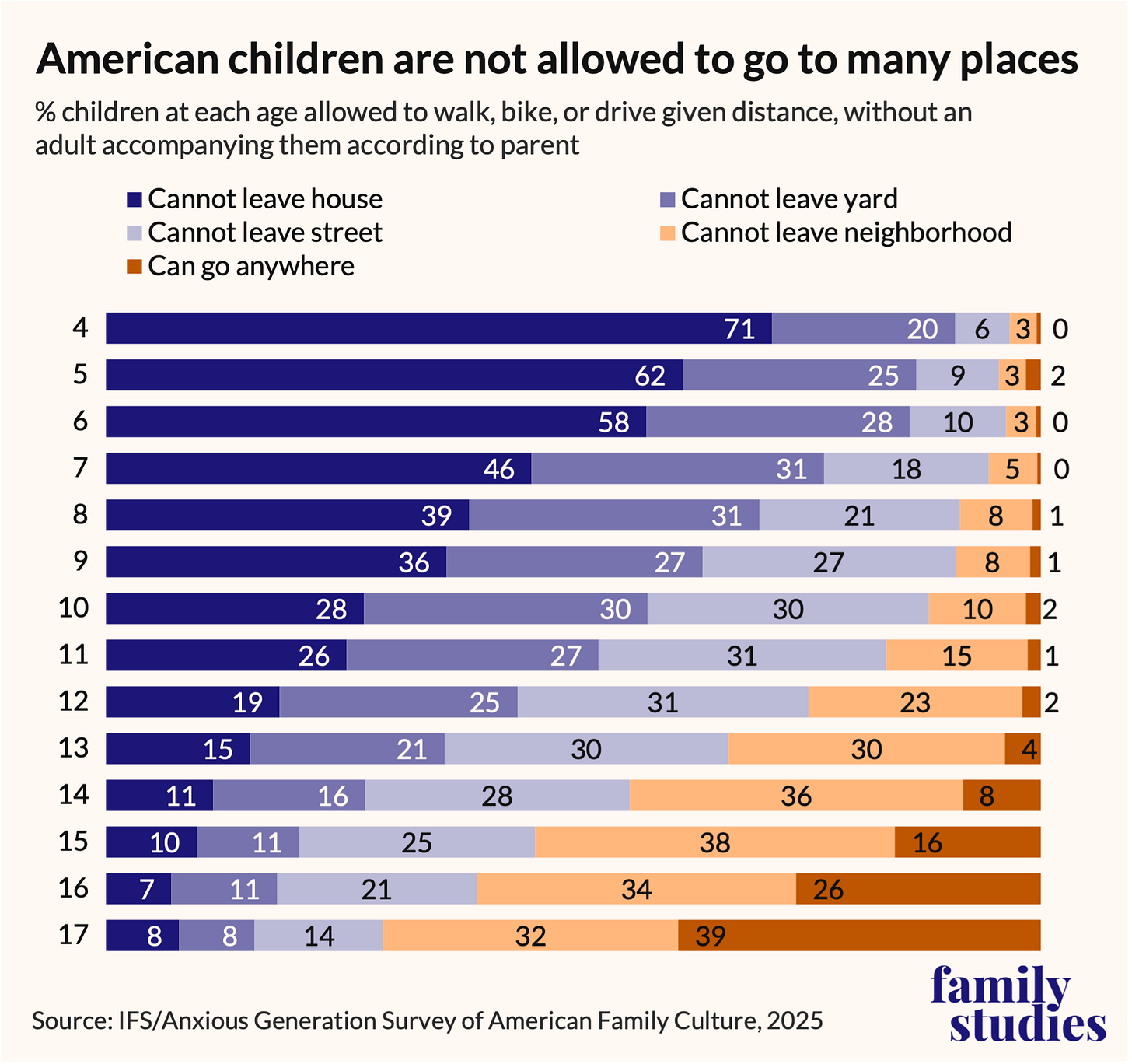
Today, 84% of 11-year-olds aren’t allowed to leave their street, with 53% not even allowed to leave their front yard. For 14-year-olds? 92% aren’t allowed to leave their neighborhood, and 55% can’t leave their streets.
In England, data show that in 1971, 86% of primary-age children traveled home from school unaccompanied. By 1990, that had fallen to 35%. By 2010, it was 25%.
What in the world happened? Why are we so afraid to let kids explore?
There’s a temptation to read this as a story about phones, screen time, or modern danger. It isn’t. It’s a story about us. The parents, coaches, and grown-ups who decided, somewhere in the last two decades, that the right amount of freedom for a 10-year-old is to be visible from the kitchen window.
We told ourselves we were keeping them safe. We were doing something else.
Why the World Shrank
When I tell people these numbers, the usual response is some version of “the world is more dangerous now.” It certainly feels that way. The only problem is that all the data we have shows it’s much safer than it was when you or I were wandering the streets. Violent crime against children has fallen steadily since the early 1990s. Stranger abductions, the thing every parent imagines when they hesitate to let a 10-year-old walk to a friend’s house, were rare in 1985 and are rarer today.
The world didn’t get more dangerous. We got more afraid.
In the 1970s, professor of communication George Gerbner coined a term for a similar phenomenon: mean world syndrome. Gerbner found that we tend to see the world as more dangerous and threatening than it is, and that it was related to the overabundance of violence on TV.
A 2008 study found that media exposure explains why Americans, in particular, often see the rest of the world as dangerous. Other research shows a link between the amount of crime reported on the news and the degree of fear people have of crime. It’s not just a worry. News consumption is related to avoidance behavior as a way to deal with the fear of violent crime. It’s not just traditional media that plays a role. A recent analysis found that social media consumption is linked to an increased fear of street violence.
When we are inundated with messages that the world is threatening, we start to believe them. The difference between the era I grew up in and today is that we weren’t constantly pinged with crime notifications from the neighborhood app or local Facebook group. These notifications make it feel like crime is abundant and happening right next door. It makes sense that our brains are primed for thinking that if our kids wander too far, they’ll get abducted. They’re working off the information they have.
A 2025 study backs this up: a fear of “stranger danger” more than doubled the likelihood of risk-averse parenting and keeping your kids contained to near the house. We’ve got a perception-reality gap that is hard to close because it involves our most precious cargo.
But it’s not all just in our heads.
Depending on where you live, cars, traffic, and more distracted people staring at their phones while driving have certainly risen. That’s a legitimate and structural concern. We absolutely need better urban design, more parks, sidewalks, etc.
But the major problem is that it’s not just people not letting their kids out of the front yard because of fear of cars, it’s that nearly all behaviors related to the autonomy of kids are down. From making their lunches to walking down a different aisle of a store, to not being able to use a knife, have all declined. We’ve not only taken away more “high-stakes” independence, like walking in the neighborhood, but also low-stakes tasks, which signals a much larger problem than just fear of abduction or cars.
Again, much of it is in response to an environment that punishes parents for giving kids autonomy. A 2023 study found that state laws are all over the place and often disconnected from what the best science indicates to be 'age-appropriate'. For example, Maryland law effectively bars children from being alone before the age of 8. In comparison, Minnesota allows 6-year-olds to be unsupervised. There is no consistent national standard, and most laws have no developmental rationale.
And this leads to another legitimate fear. No one wants to be reported to child protective services. And it happens at an astonishing rate. According to a 2017 study, approximately 38% of all children will be investigated by CPS by the time they are 18. And the majority of those cases aren't about abuse. They're about supervisory neglect, children being somewhere without an adult.
This ties into another element that prevents parents from lengthening the leash: the judgment of others. If there’s one thing that’s skyrocketed over the last few decades, it’s certainly judgment. With social media and other outlets, we walk around criticizing anyone and everyone. According to recent data, 25% of parents admitted they had personally criticized another parent for not adequately supervising their child. So, a quarter of parents are walking around as the enforcement mechanism.
Research published in 2024 found that “intensive parenting attitude” produces stress, anxiety, depression, and guilt in mothers. We feel guilty when we aren’t always on, always there. We feel like bad mothers and fathers.
The feeling creates anxiety, and that anxiety pushes us towards overprotecting. And we’re well aware of it. In fact, we want better. We just don’t follow through.
In a survey of parents of 5-11-year-olds, four out of five parents actually agreed that unsupervised free time is good for kids. They wanted more of it. But in practice:
Only 50% would let a 9-11-year-old find an item at the store while they shopped in another aisle
Only 15% would let them trick-or-treat without an adult
Only 20% of 5-8-year-olds prepare their own snack
The top reported fear was that “someone might scare or follow” the child
And the kicker is that it largely wasn’t about actual danger, as only 17% reported living in an unsafe neighborhood. The researchers concluded that parents “may be unintentionally restricting their child’s path to independence.” They want to let go. They just can’t.
The Consequences of Safetyism
We live in a culture of safetyism. And it’s largely an English-speaking phenomenon. These same views aren’t held in other countries. For example, a 2023 study found that while English-speaking parents generally expect kids to handle some independence around 9 or 10, Japanese and Kenyan parents expect that same level of independence at 5 or 6.
Similarly, in an international study that looked at 7 to 15-year-old children across 16 different countries, they found that most English-speaking countries were in the lowest autonomy tier (12th- Ireland, 13th- Australia, 16th- South Africa). Americans weren’t surveyed, but countries like Finland, Germany, Norway, Sweden, Japan, and Denmark scored highest on autonomy. For example, in Finland, the majority of 7-year-olds are routinely allowed to walk or bike alone. And by 8, the majority of kids cross main roads, commute to school, and navigate their neighborhoods unaccompanied.
Once again, part of this is structural, with easy access to bikes and such, and we should absolutely address that. But increasingly, the data points to a large part of this being the safetyism that has taken hold in places like America.
Safety is preventative. It’s the impulse to prevent every possible discomfort, fall, or bruise. It's making sure that there aren't monkey bars at a playground so that no one can fall. It's providing trigger warnings, so that people can walk out, rather than facing potential discomfort in the classroom. Safetyism provides the illusion of security. It appears to be care, but in reality, it’s avoidance.
We confuse safety with security, and they aren’t the same thing.
Security is something different. It’s knowing that if you fall, someone you trust will help you get back up. It’s the idea of knowing that if you make a mistake in the office, you should let others know so that you can improve the processes, instead of hiding it away for fear of losing your job. Security gives you a base to explore from. Safety builds walls.
The strange thing is that the more we choose safety over security, the less of either we get. A 2024 meta-analysis on trigger warnings found that they make no difference at best, and at worst, they increase anxiety, because our predictive brain prepares for the disaster we just got warned about. Watch what happens at recess when adults always step in to mediate. Children stop learning how to resolve their own arguments. Watch what happens when a parent always rescues a child from a hard math problem. The child stops trying, learning that mom or dad is there to save them.
It’s part of the reason (along with phones, social media, etc.) that we’ve had such an alarming surge in youth mental health issues. According to the CDC, 40% of US high school students reported persistent feelings of sadness or hopelessness in 2023, up significantly from earlier data. Suicide among children under 15 rose 3.5-fold between 1950 and 2005, then another 2.4-fold by 2020.
A 2020 longitudinal study followed 500 adolescents from age 12 through 19. The teens whose parents stayed at persistently elevated levels of psychological control across those seven years showed measurably worse trajectories of both depression and anxiety. A 2024 meta-analysis of 52 studies on overparenting confirmed the pattern: across cultures and income levels, overparenting predicts higher rates of depression, anxiety, and internalizing symptoms in offspring. When we eliminate the small discomforts that build emotional regulation, we don't make kids safer. We make them more anxious.
It’s why Peter Gray and colleagues writing in the Journal of Pediatrics concluded, “A primary cause of the rise in mental disorders is a decline over decades in opportunities for children and teens to play, roam, and engage in other activities independent of direct oversight and control by adults.”
The Power of Freedom
Early in my (Steve's) high school coaching career, I learned a hard lesson that stuck with me. It was easy to get someone to finish a workout while I was standing there watching them. I could get a 14-year-old freshman to do lots of mile repeats or go on a 10-mile run if I, as the coach, was running with them. But what ultimately mattered and determined their success was what they did when I wasn’t. Did they do their runs over the summer when we didn’t have practice, or run the whole way instead of walking and taking shortcuts when we ran at the local park? That’s what mattered.
And research shows that when we use a leadership style where the coach is highly authoritative and emphasizes control, kids work hard while they are physically there, but not when the coach is absent. On the other hand, autonomy supportive coaching, where the coach lengthens the leash and empowers agency, leads to increases in intrinsic motivation, self-belief, confidence, and even resilience.
Our brains and bodies are meant to be stressed appropriately. Just like a muscle needs to feel the strain of lifting a weight or running a mile to adapt and grow, humans need exposure to just manageable risks, peer conflict, and personal discomfort to properly wire our executive function and build cognitive resilience.
Pickup games are the lab where children practice being human. Research shows kids learn to solve conflicts and disagreements on the sandlot or at recess. Playgrounds are where kids learn to take appropriate risks for their current capabilities. They don’t know if they can climb the wall, hang on the monkey bars, or whatnot until they try.
When we replace the sandlot with the travel league, we replace the curriculum with a script. The coach picks the teams, calls balls and strikes, and intervenes during any conflict. We learn to outsource everything. The thousand small acts of judgment that built emotional regulation in previous generations have been quietly handed back to the grownups.
Similarly, when we’re never given the chance to bike to our friend's house, walk to school, or explore the world around us, we’ve created an artificially small world. Not only do we never develop our internal spatial awareness, but we also ingrain a mental model that says the outside world is dangerous and we are not capable of navigating it. We never learn to make risk assessments ourselves. And as we are learning, an appropriate assessment of risks, rewards, and our capabilities is what our brain decides whether to work hard, give effort, or not. If our brain is convinced everything is risky, we default to “why try mode.”
By completely removing unsupervised exploration, we’ve inadvertently denied kids the raw material required to overcome normal developmental anxieties. The things that helped develop self-regulation, conflict resolution, and an internal locus of control…are gone.
It’s as if we took everyone in school and said, use AI to solve all of your work because doing math, staring at a blank page to write, or giving a speech is too uncomfortable. Sure, we might complete the assignments, and they’ll have the appearance of doing math, writing an essay, and so forth…but there’s zero learning going on.
By stepping in to eliminate all minor discomforts and physical risks, parents disrupt the child’s capacity to learn through physical trial and error. In many ways, we’ve systematically engineered learned helplessness.
Lengthening the Leash
In our coaching work, we tell every person the same thing on day one: my goal is to make myself increasingly obsolete. We're trying to coach them toward independence, not dependence. That doesn’t mean we disappear or check out. It means we gradually give away control, in small bites, until they are the ones steering the ship. Our role slowly shifts to guide, mentor, or even a co-pilot on the journey.
To get there, you have to gradually give away responsibility and choice. Sure, it may start with you dictating the workouts precisely. But over time, you ask and collaborate more (What do you think? What would you do?). You hand over decision-making. At first, it might be something simple: Do you think you can do one or two more reps? But over time, you provide more responsibility and autonomy. Those are the ingredients that build self-reliance, toughness, and a sense of agency.
The late Kobe Bryant put it well. When watching his daughter's basketball practice, there was a parent on the sidelines encouraging and yelling at their daughter with things like “Dig deep!" After practice, Bryant pulled that parent aside and said, “When she’s doing those line drills, don’t say anything. Because there’s a conversation that’s happening inside her head. She’s talking to herself, pumping herself up to do it. So, for an outside voice to come in to give her guidance and the push to keep going actually interrupts her process. Let her be. Let her figure it out herself.”
Parenting works the same way. If we’re always the person dictating and controlling, it might look and feel like the right thing in the moment. But too often, we’re preventing them from developing the exact skills that allow them to thrive when we’re not there.
So, of course, we need to fix the structural elements to allow our kids to roam. Of course, we want violence and danger to be low, and we should be aware of the safety level of any given environment. And of course, a 5-year-old is going to have a different leash length than a 10 or even 15-year-old. But… we’ve got to let them navigate discomfort, to feel bored, to face conflict, to wander. Those are the building blocks of confidence, resilience, self-determination, and emotional regulation.
We think about this when we watch our own young sons and daughters. Every instinct in us wants to fix the small problem before it becomes a hard one. As people with OCD, there’s always a tinge of fear of what will happen when our oldest reaches for those monkey bars or climbs the rock wall that I’m not quite sure if she can handle yet. Part of my brain is always screaming “Danger! Intervene!” But just like we learned with OCD, not every feeling or thought needs power. Sometimes we have to sit with it, realize that the world isn’t on fire and that we aren’t going to die. And eventually, that thought quiets down to its rightful level.
Every parent we know has similar instincts. We aren’t bad parents. We’re just living in a world that has conditioned us to be afraid. But the kindest thing I can do, the thing that will actually make our kids resilient, is to let the small problems happen. To let them negotiate and solve problems with their friends. To let her ride further than I’m comfortable with. To gradually, appropriately lengthen that leash.
-Steve and Brad
Listen: How to Get Small Wins out of Bad Days
We've all got those days: you can't seem to get started, your motivation is low, or something comes up and throws you off track. It happens to all of us! It only becomes a problem when a bad start to the day becomes a bad day, and then a bad couple of days, and then a bad week, and then a bad month... on and on. High-performers who have sustained success over many years are elite at getting something out of days when they're not at their best. Today's episode of "excellence, actually" is all about building your capacity to do the same. Because if you can squeeze a small win out of a day that might otherwise be a zero, those little victories add up into something big over time.
— Clay
For daily insights, ideas, and practices, be sure to follow us online:
Weekly ideas about living a good, meaningful and high performing life in a chaotic world from Brad Stulberg and Steve Magness. Best selling authors of PEAK PERFORMANCE, DO HARD THINGS, and THE PRACTICE OF GROUNDEDNESS.
Reflect: When to Quit and When to Grit "Sometimes our behavioral inertia pulls us forward, toward continuing. Our thoughts latch onto a pursuit we've been after for years. We experience feelings of regret or remorse if we don't accomplish our goal. Our ego screams that we came this far, and we can't face our friends if we fail. The tough decision is to turn around, walk away, and quit… We often equate toughness with persistence, but in some cases, it's the exact opposite. Toughness is...
Reflect: Responding Instead of Reacting True toughness means offering challenge folks, but offering support along the way. It's feeling all of your emotions, understanding they are messengers instead of dictators. It's seeing failure as a necessary part of growth and development. It's sometimes persisting, and others quitting to live to fight another day. It's allowing for exploration, imperfection, and everything in between. The route towards such toughness doesn’t lie in being callous, but...
Reflect: Process vs. Outcomes "The problem isn't outcomes or results themselves. It's what we do with them. We've swung too far to one side of the spectrum, making winning the soccer game or being named salesman of the month an essential part of validating our self. It's not about not keeping score; it's that we've made the score the only thing. We need to rebalance the equation. We must hold onto the idea that outcomes matter, but we should decouple our character from the result and...