Weekly ideas about living a good, meaningful and high performing life in a chaotic world from Brad Stulberg and Steve Magness. Best selling authors of PEAK PERFORMANCE, DO HARD THINGS, and THE PRACTICE OF GROUNDEDNESS.
In a series of studies, Mahoney and colleagues looked at cross-country runners and rowers, two individual sports where suffering and working through pain and fatigue are the norm. In over 200 runners, satisfying the three basic needs was related to toughness and improved racing times. When Mahoney dug deeper into the data, he found that the social environment, primarily impacted by the coach, played a large role in whether athletes were able to meet these needs. If the atmosphere was supportive and fostered autonomy and a sense of belonging, then the athletes were tougher and performed better. As Mahoney concluded, toughness resulted from “coaching behaviors that promote psychological needs satisfaction.”
When you get into coaching, you think it’s about the X’s and O’s, the workout design, or crafting the perfect program. It’s what almost all of our coaching education is set up for. In colleges, we often throw it in with sports science as a major. In the certification courses, whether it be for strength training or track and field, most of the course covers training plan design. All of that stuff is important.
But it misses out on what actually makes a difference. You can have the perfect training plan, and it won’t matter if you haven’t gotten the buy-in.
I was once one of those coaches who was obsessed with the plan. Then, I walked into an 8 a.m. summer course while in grad school at George Mason University. There were a dozen of us stuck in a basement-level classroom from 8 to noon. But unlike any other summer course, we were all excited to be there. Even if we were unsure of what to expect.
Charley Casserly had been a Super Bowl-winning general manager for the Washington Redskins, and then later helped to get the Houston Texans started. As a native Houstonian, coming across his name in the syllabus was the entire reason I voluntarily spent the next few months of my precious summer break in that room.
We got to talk with NFL coach Brian Billick, and a slew of other football and basketball coaches about leadership and culture. We did mock crisis management for the latest scandal that hit the NFL that summer. (I’ve still got one NFL team’s crisis management checklist on my computer as we speak.) Among my classmates, we joked that the class should have been called “How to be an NFL General Manager or Coach.”
But one exercise really stuck with me: the culture and leadership handbook. What did you want to stand for, how did you want to lead? Casserly’s big message is that we’re all leaders, even if it’s not in our title. And that there are multiple ways to do so. You had to figure out a style that was authentic to you and set the culture you wanted. But most importantly, that handbook had to be actionable. He told us to cut the fat and make it the core principles that you want to stand for. And then told us to revise it every year. It’s still a practice that I revisit.
This week, I’m heading back to George Mason University to receive their College of Education and Human Development Distinguished Alumni of the Year. I went there for a master's in sports science. I literally talked my way into the program before taking the GRE entrance test and 6 months past the application deadline by talking about lactate dynamics with the exercise physiology professor… But I walked out of there with a different appreciation of coaching. One that set the standard for my career. So with that, a few lessons from my handbook that have survived every annual revision:
Reward the work
There’s some simple math that applies to just about every pursuit. You spend months training for a race that lasts a few minutes. You’ve got maybe a half dozen shots to see the rewards of your work. For just about any pursuit, you spend 99% of your life on the climb and a fraction of 1% at the summit. If you rely on the view from the top to justify the struggle of the ascent, the equation will never balance out. You have to find meaning in the climbing itself.
It’s so easy to reward the result. We can see it right there: you won the race or set a new personal best. But what we reward gets incentivized. If all I’m doing is yapping on and on about the result, athletes internalize that’s all that matters. Of course the win matters, but you’ve got to find a way to counterbalance that. In running, it’s why teams have summer mileage clubs to emphasize who did their job over the summer break. Or why we’d track consistency of showing up in our training logs. Or, after a hard interval session, we’d gather around as a team, and athletes would give shout-outs to other team members. The key was it couldn’t be about some phenomenal split an athlete ran; it had to be some action they took: fighting through a tough workout, encouraging others on the rest breaks, lifting their team up.
When you put the work first, even after a bitter defeat, there’s a hint of progress that you can hold on to.
Teach, don’t just train
Too often, we forget that coaches are teachers. Our goal is to fundamentally change the person sitting in front of us. By the end of the season, they should have a different level of fitness and knowledge. We forget that to get to that change, we need to not only give instructions or great speeches, but to really make sure they are absorbing the lesson.
Anyone can write a great training plan, and maybe even get someone hyped. But the point is to help that person grow. It’s to make sure they leave as a better person. You have to teach people how to handle challenges instead of just blindly throwing them in.
Be the counterbalance
When everything is pushing you in one direction, you’ve got to pull in the other.
Texas A&M football coach Mike Elko put it well: “My job is to be calm and collected when they’re frantic. My job is to create intensity when they’re not intense. My job is to always be opposite the moment.” This applies not only to their mood but also to how they view their pursuit. If someone is overly focused on the short-term, your goal is to bring perspective. To get them to zoom out and see the big picture. Or, if they are so broad that they forget that the outcome actually does matter and that it’s time to compete, you may need to emphasize the short-term.
High demand, high support
We often frame coaching as either you do your best impression of some dictator drill sergeant or you're a nice guy player's coach. Coaching and parenting research tells us it’s not an “either/or”—it’s a both-and. The best methods marry high demand with high support. You have standards, but the kid knows you are there to help them.
Care and standards go hand in hand. Everyone is going to get there in their own unique way. But we need both.
Create Space for Learning
Former Pittsburgh Penguins coach Mike Sullivan tries to build what he calls a “safe zone for learning.” This can be seen in how he handles video review sessions. In team sports, these sessions often turn into a kind of call-out show. Who messed up is on public display, and that almost inevitably puts them in defensive mode. Their instinct is to protect their ego, which takes them out of learning mode. “We don’t want a player walking into our video room on eggshells worried about ‘Am I going to be in the film? Is Coach going to yell at me?’ It’s a game of mistakes. Our responsibility is to learn from them.”
It’s a lesson I learned from legendary sprint coach Tom Tellez. Attack the problem, not the individual. You want to be part of a partnership for improvement. Yes, you want people to be accountable, but when it’s learning time, it’s more about how we correct and grow. If a kid is scared to death of what you’ll see in practice when they mess up, you’re priming them to live in protection mode.
Always leave the door open
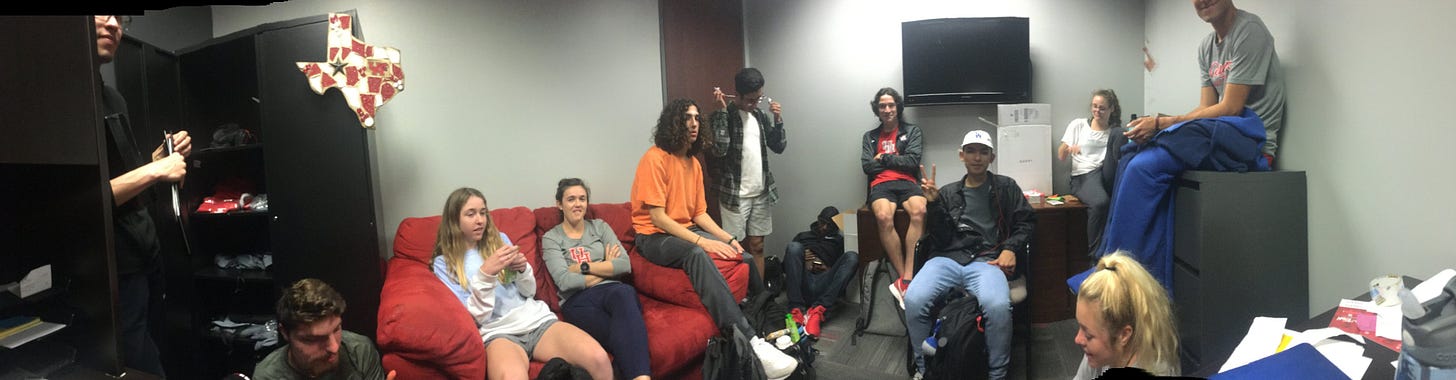
My rule when I was coaching college athletes: always leave my door open. Athletes knew they could stop by, talk, sit and do homework, or just lounge around. And they did. At some points we had upwards of 14 athletes jam-packed into a small office.
First, I learned that the space had to be inviting. I scoured the building for as many chairs as I could fit inside. Found a small couch some other coach had abandoned. And even made sure my drawers and cabinets were places where people could sit. I even let athletes decorate the place. Create a space that invites people in. And they feel ‘ownership’ in it.
And then take note of who stops by and who needs a little nudge. I’d do weekly small group sessions of 4-5 athletes at a time where we’d pick a topic, and I’d lead a discussion on it. Inevitably, that led to a few athletes who rarely visited lingering and talking.
Much of the conversation started about sport, but that space led to more discussions about life than I could have ever guessed. And it’s in those conversations that our culture and leadership were formed. The office was where buy-in was earned. As Casserly told us, “Prior success only buys you time. Show players you genuinely care about them and that you know how to help them succeed.”
Give athletes choice
Sport is often a top-down model. The coach says to do X, Y, and Z, and the athletes do it. Seldom do we give them one of the key building blocks of intrinsic motivation: autonomy.
It feels weird to give power away, to let an athlete make a decision that’s normally reserved for you. But in doing so, you not only increase their motivation, but you give them ownership, a voice, and train the building blocks of toughness. Think of it like this. An athlete who is yelled at and screamed at to do one more sprint by a strength coach might get that sprint in. But they internalize that they only push when someone is screaming at them. Instead, if that athlete has a say in when they’re done, now they’ve got to wrestle with that inner devil on their shoulder. Sure, sometimes they might stop early. But that’s the point: you give them a say so they have to choose, and hopefully reflect and learn from it.
You don’t do this all the time. But put your athlete in positions to decide, especially as they grow and develop. The more experienced the athlete, the longer the leash. You’re empowering them to learn instead of just following.
—
Fifteen years later, I’m walking back into that building. The handbook has been rewritten more times than I can count. But the core of what Casserly made us do hasn’t changed: figure out what you stand for, make it actionable, and keep revising. The plan matters. The person in front of you matters more.
Going back through my notes from that class, here were a few coaches' breakdowns of two all-time great QBs. Maybe you can guess which ones... QB 1: “Great work ethic.Studies game plan religiously…Makes everyone feel like he is their best friend. In turn, they want to help him when he needs it.”
QB 2: "Will wear out the 3rd QB. Attention to Detail. Physically and mentally prepared 24/7...Doesn’t care if he’s liked. Can be abrasive. Will challenge the players and coaches at practice if he does not like what he sees."
It's Tom Brady and Peyton Manning. They found different ways to lead and get to the top, but both were founded on the work.
More Good Stuff:
How to be good on your bad days...and 14 other lessons from Steve on coaching. Plus: If you watched the Nick Saban documentary, Steve breaks down where teams go wrong with the 110-yard sprints workout in the doc, and how to do it better.
Here's a free invite to a virtual conference all about connection and humanity in an age of automation and AI. Brad was a participant, along with many other great thinkers such as Dave Epstein, Angela Duckworth, Priya Parker, Charles Duhigg, Will Guidara, and more.
Listen: "Recovery, Actually — Listener Questions on Rest, Aging, and Turning Off"
We've always been big on recovery. (After all, it is one half of the growth equation: stress + REST = growth.) But knowing how to recover, both physically and mentally, is a skill — and one that needs to be refined as we age and as our world becomes increasingly stimulating. So today on "excellence, actually" we are answering four questions from dear listeners (you!) about how to handle physical changes, cognitive overload, and the sheer velocity of modern life. Plus: some emergency recovery tips for when you're going through a really tough stretch.
For daily insights, ideas, and practices, be sure to follow us online:
Weekly ideas about living a good, meaningful and high performing life in a chaotic world from Brad Stulberg and Steve Magness. Best selling authors of PEAK PERFORMANCE, DO HARD THINGS, and THE PRACTICE OF GROUNDEDNESS.
Reflect: When to Quit and When to Grit "Sometimes our behavioral inertia pulls us forward, toward continuing. Our thoughts latch onto a pursuit we've been after for years. We experience feelings of regret or remorse if we don't accomplish our goal. Our ego screams that we came this far, and we can't face our friends if we fail. The tough decision is to turn around, walk away, and quit… We often equate toughness with persistence, but in some cases, it's the exact opposite. Toughness is...
Reflect: Responding Instead of Reacting True toughness means offering challenge folks, but offering support along the way. It's feeling all of your emotions, understanding they are messengers instead of dictators. It's seeing failure as a necessary part of growth and development. It's sometimes persisting, and others quitting to live to fight another day. It's allowing for exploration, imperfection, and everything in between. The route towards such toughness doesn’t lie in being callous, but...
Reflect: Process vs. Outcomes "The problem isn't outcomes or results themselves. It's what we do with them. We've swung too far to one side of the spectrum, making winning the soccer game or being named salesman of the month an essential part of validating our self. It's not about not keeping score; it's that we've made the score the only thing. We need to rebalance the equation. We must hold onto the idea that outcomes matter, but we should decouple our character from the result and...